|
Из архивов
России
http://www.nns.ru/archive/center/2000/11/01.html#c6
Вступая в противоборство с
Западом, Сталин отлично понимал, что поддержка ярых
противников американского империализма ему обеспечена
изначально. Однако Кремлю было важно привлечь на свою
сторону и людей иного склада — тех, кто болезненно воспринял
раскол антигитлеровской коалиции и мечтал о нормальном
сосуществовании СССР и западных государств. Этот контингент
следовало убедить, что Кремль втянут в холодную войну помимо
своей воли и что ключом ко всеобщему умиротворению являются
успехи просоветских сил. Не случайно самым ярким брэндом
международного коммунистического движения в те годы был
знаменитый "Голубь мира" Пабло Пикассо.
Печатные издания (в
частности, "Труд",
»Коммерсантъ»)
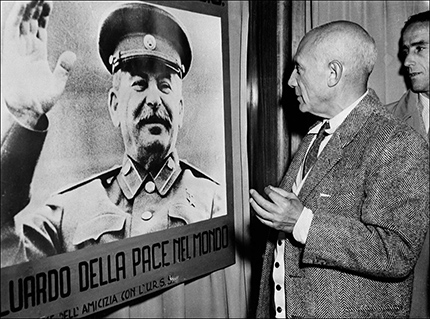
пишут сегодня о художнике Пабло Пикассо. «Труд» сообщает,
что в Берлине открылась выставка произведений Пикассо «Объятие»,
которую организовал его сын - Клод.
Но Пабло Пикассо, отмечает
«Коммерсантъ», был не только гениальным художником, но и
членом Французской компартии и намеревался написать
героическое полотно с обнаженным
Сталиным.
Однако передумал, убоявшись
критики своих товарищей по партии, и без того сурово
осуждавших его за неприятие социалистического реализма,
правда, при этом охотно получавших от него материальную
помощь.
Подробности творческих планов
гения относительно обнаженного Сталина изложены в книге
английского исследователя Джердже Атлея "Коммунистические
годы", изданной Йельским университетом. Пикассо вступил в
компартию во время нацисткой оккупации Франции. После войны
художника, правда, не заставляли ходить на партийные
собрания, но он часто украшал президиумы всевозможных
партийных мероприятий, а главное -
дарил свои картины
руководству ФКП, которая затем продавала их для пополнения
партийной кассы.
В тот период своей жизни Пикассо
искренне верил в идеалы коммунизма, но его долго не
удавалось уговорить написать Сталина. Однако два раза он
поддался. Первый - в 1949 году, когда отмечалось 70-летие "вождя
народов". Правда, в этот раз художник ограничился аллегорией,
нарисовав руку с бокалом вина, а над бокалом слово "Сталин",
окруженное лучами, и ниже - "За твое здоровье!"
Панибратский рисунок вызвал
резкую критику товарищей по партии. Но ее можно было считать
пустяком по сравнению с бурей страстей по поводу другого
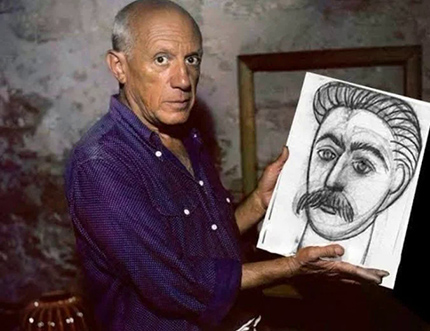
произведения Пикассо, созданного по настойчивой просьбе
руководства ФКП в связи со смертью Сталина в 1953 году. В
газете Les Lettres francaises появился портрет вождя с
глазами мечтателя и крепким подбородком бойца, который
художник, судя по всему, с максимально возможным для него
приближением к реализму срисовал с фотографии молодого Сосо
Джугашвили. На следующий день коммунистические издания
L`Humanite и France Nouvelle обрушились на Пикассо за "оскорбление"
памяти руководителя международного коммунистического
движения. А 18 марта, когда не прошло и двух недель после
кончины Сталина, секретариат ЦК ФКП принял заявление, в
котором "категорически" осудил публикацию портрета Сталина,
"выполненного товарищем Пикассо".
Писателя Пьера Дэ, который был
одним из руководителей Les Lettres francaises, послали
успокоить Пикассо, так как опасались его резкой реакции. Дэ
записал разговор с художником, и, к счастью, у него хватило
юмора, чтобы оценить монолог Пикассо. Художник сказал
посланцу партии: "Нарисуй я Сталина старым, с морщинами,
мешками под глазами, все закричали бы: 'Как ты смеешь
рисовать его стариком!' Поэтому я даже в какой-то момент
собирался нарисовать его в героическом духе, обнаженным. Да,
думал я, это здорово. Но как быть с его мужскими
причиндалами? В классических скульптурах члены всегда
маленькие. Но ведь речь идет о Сталине, мощном мужике,
настоящем боевом быке. Но если ему приделаешь бычий член, за
которым нарисуешь маленького Сталина, будет еще хуже. Тогда
все закричат: 'Ты превратил его в сексуального извращенца!"
А потом Пикассо добавил: "Конечно,
если ты настоящий реалист, то берешь линейку и измеряешь
свой собственный аппарат. Но тогда ты превратишь Сталина в
ординарного человека. Даже если ты готов собой пожертвовать
и для полного реализма сделаешь слепок своего члена, а потом
воспользуешься им в работе, то еще хуже набросятся: 'Ты что,
решил, что ты - Сталин?!' Я уж не говорю о том, что у
Сталина, должно быть, никогда эрекция не прекращалась. Нет,
ты скажи мне, раз уж так разбираешься в социалистическом
реализме, Сталина надо рисовать с эрекцией или без?"
Несколько лет спустя, когда и во
Франции узнали о преступлениях "великого вождя", Пикассо,
встретившись с Дэ, язвительно спросил его: "Теперь, надеюсь,
вы не скажете, что я слишком благожелательно нарисовал
Сталина?" |
From the archives of Russia
http://www.nns.ru/archive/center/2000/11/01.html#c6
In entering into
confrontation with the West, Stalin was well aware that he
was guaranteed the support of ardent opponents of American
imperialism. However, it was important for the Kremlin to
attract people of a different nature to its side—those who
were deeply affected by the split in the anti-Hitler
coalition and dreamed of a normal coexistence between the
USSR and Western states. This contingent had to be convinced
that the Kremlin was being drawn into the Cold War against
its will and that the key to universal pacification lay in
the success of pro-Soviet forces. It is no coincidence that
the most prominent symbol of the international communist
movement in those years was Pablo Picasso's famous "Dove of
Peace."
Printed
publications (in particular, Trud and Kommersant) are
writing about the artist Pablo Picasso today. Trud reports
that an exhibition of Picasso's works, "Embrace," organized
by his son, Claude, has opened in Berlin.
But Pablo
Picasso, Kommersant notes, was not only a brilliant artist
but also a member of the French Communist Party and intended
to paint a heroic canvas of a nude Stalin. However, he
changed his mind, fearing criticism from his party comrades,
who already harshly condemned him for his rejection of
socialist realism, although they willingly accepted his
financial support.
Details of the
genius's creative plans for the nude Stalin are outlined in
the book "The Communist Years" by the English scholar George
Atlay, published by Yale University. Picasso joined the
Communist Party during the Nazi occupation of France. After
the war, the artist was not forced to attend party meetings,
but he often decorated the presidiums of various party
events and, most importantly, donated his paintings to the
PCF leadership, which then sold them to replenish the party
coffers.
During this
period of his life, Picasso sincerely believed in the ideals
of communism, but he was long thwarted in persuading himself
to paint Stalin. However, he gave in twice. The first was in
1949, during the 70th anniversary of the "leader of the
people." This time, however, the artist limited himself to
an allegory, drawing a hand holding a glass of wine, with
the word "Stalin" surrounded by rays of light above the
glass, and below, "To your health!"
The familiar
drawing drew sharp criticism from his party comrades. But
this could be considered trivial compared to the storm of
passion surrounding another Picasso work, created at the
insistent request of the PCF leadership following Stalin's
death in 1953. The newspaper Les Lettres francaises
published a portrait of the leader, with the eyes of a
dreamer and the strong chin of a fighter. The artist,
apparently, copied, as close to realism as possible, from a
photograph of a young Soso Dzhugashvili. The following day,
the communist publications L'Humanite and France Nouvelle
attacked Picasso for "insulting" the memory of the leader of
the international communist movement. And on March 18, less
than two weeks after Stalin's death, the Secretariat of the
PCF Central Committee issued a statement "categorically"
condemning the publication of a portrait of Stalin "done by
Comrade Picasso."
The writer
Pierre Daix, who co-directed Les Lettres Francaises, was sent
to calm Picasso, fearing a harsh reaction. Daix recorded the
conversation with the artist, and fortunately, he had enough
humour to appreciate Picasso's monologue. The artist told
the party envoy: "If I were to draw Stalin as an old man,
with wrinkles and bags under his eyes, everyone would shout,
'How dare you draw him as an old man!'" That's why, at one
point, I even considered painting him in a heroic spirit,
naked. Yes, I thought, that's great. But what about his male
genitals? In classical sculptures, penises are always small.
But we're talking about Stalin, a powerful man, a real
fighting bull. But if you attach a bull's penis to him,
behind which you draw a small Stalin, it will be even worse.
Then everyone will scream: 'You've turned him into a sexual
pervert!'
And then Picasso
added: "Of course, if you're a true realist, you take a
ruler and measure your own apparatus. But then you'll turn
Stalin into an ordinary man. Even if you're willing to
sacrifice yourself and, for the sake of complete realism,
make a cast of your penis and then use it in your work,
they'll pounce even worse: 'What, have you decided you're
Stalin?!'" Not to mention that Stalin must have never lost
his erection. Tell me, since you're so well-versed in
socialist realism, should Stalin be painted with or without
an erection?"
A few years
later, when France also learned of the "great leader's"
crimes, Picasso, meeting with Daix, sarcastically asked him:
"Now, I hope you won't say I've painted Stalin too
favourably?" |
 home
about
artists
exhibitions
press
contact
purchase
home
about
artists
exhibitions
press
contact
purchase